
SMGWforwards
for the successful implementation of the BMWK/BSI phased model
As part of the collaborative project “SMGW-forwards – Real-World Laboratory for the Further Development of the SMGW Infrastructure for the Successful Implementation of the BMWK/BSI Phased Model,” PPC worked together with four project partners on the rapid and comprehensive implementation of the BMWK roadmap for the digitalization of the energy transition. The project’s goal: to develop the functionalities of smart meter gateways and the surrounding systems and processes in accordance with the phased plan, leading to an expanded intelligent metering system (iMSys). The project consortium encompassed all relevant stakeholders, from SMGW manufacturers and software solution providers to end users. The advanced intelligent metering system rapidly opened up a wide range of relevant use cases to the market, thereby supporting the energy and transportation transitions.
Challenges
The certified SMGW communication platform already offers a wide range of applications for addressing the challenges of digitalization in the energy sector. As the phased implementation plan continues to take shape, the range of applications for smart meter gateways is expanding. The SMGW-forwards project therefore addresses the following issues:
Research Questions
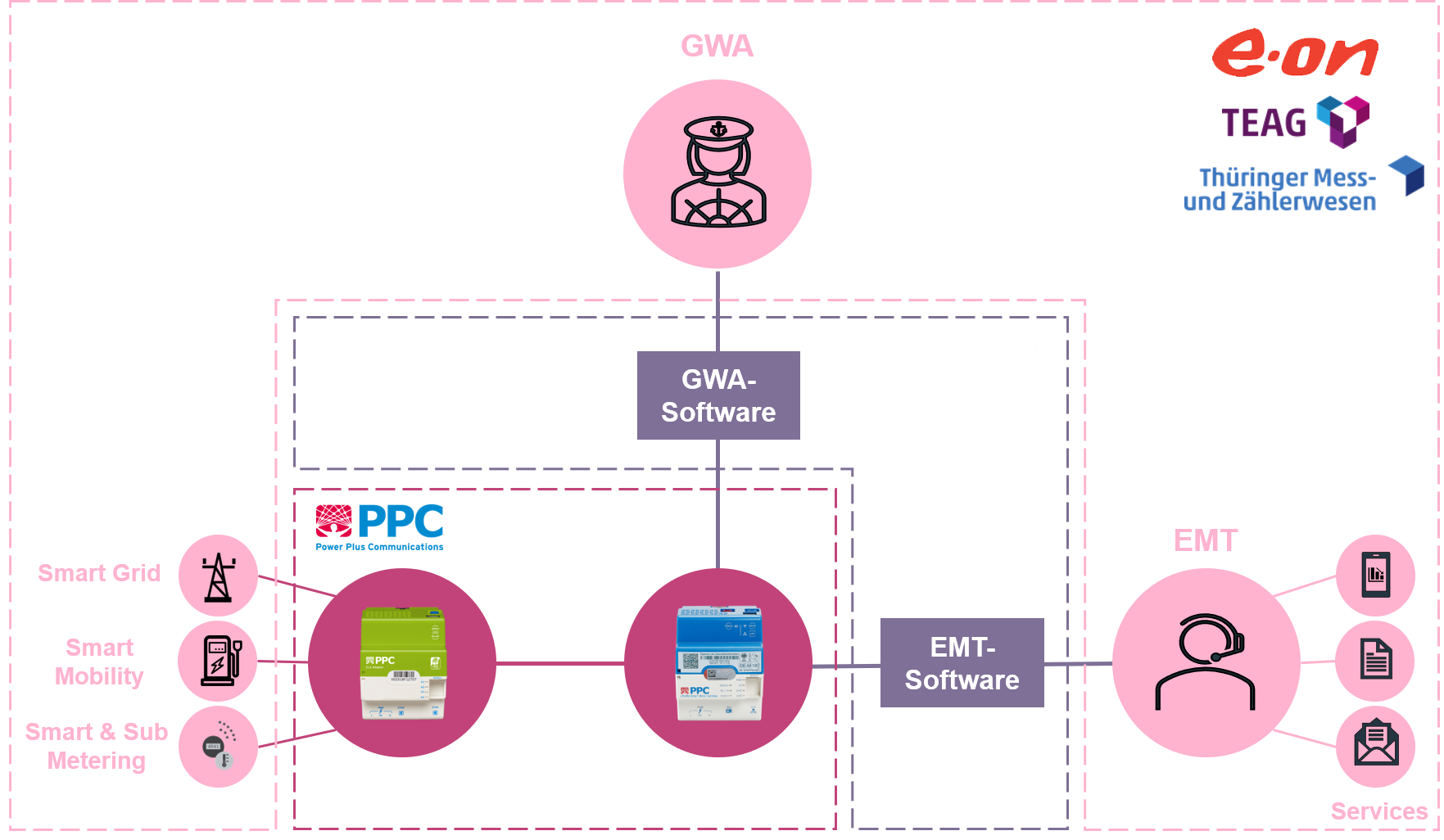
Smart Grid
In the field of smart grids, how can the iMSys be used to improve the efficient and secure integration of decentralized generation and consumption facilities into the power grid and the energy market?
Excerpt from standardisierungsstrategie.pdf (bmwk.de)
5.2.2 SMGW Communication Platform for the Smart Grid Application Area
The Smart Grid Cluster is a key driver of the digital transformation of the energy transition for the SMGW communication platform. With the increasing importance of renewable energy for the energy supply and the growing number of controllable installations, there is a growing need for energy monitoring and management to ensure grid stability.
The digital energy system must be capable of enforcing predefined maximum limits for power consumption and feed-in in certain (particularly time-critical) situations. As part of the implementation of smart grid use cases for feed-in and load management, grid-supporting control and energy management use cases must be tested. The logical or physical connection of the control unit via the SMGW communication platform ensures secure integration into the smart grid.
To implement secure control management in the style of the “grid traffic light” system via the SMGW communication platform, additional BSI guidelines will need to be developed. Specifically, the system components involved must be able to distinguish, during the yellow and red phases, who has direct authorization to implement the necessary control measures for the decentralized system in order to prevent malfunctions.
Smart Mobility
In the field of smart mobility, how can public and non-public charging sessions be reliably tracked and billed using iMSys?
Excerpt from standardisierungsstrategie.pdf (bmwk.de)
5.2.3 SMGW Communication Platform for the Smart Mobility Application Area
Section 48 of the Metering Point Operations Act already outlines the binding minimum requirements for the secure integration of electric vehicle charging station infrastructure into the smart grid. SMGW communication platforms are also expected to be the standard solution here in the future. With the growing number of decentralized
energy producers and the increasing share of flexible energy feeds into the smart grid, there is a growing need for better predictability in planning generation and consumption.
Electric vehicles are ideally suited to serve as flexible consumers of electricity from renewable energy sources—both in terms of location and time—with high buffering capacity. They can compensate for sudden grid fluctuations when powerful and reliable communication and energy management systems are in place. The goal of optimally integrating grid-friendly storage systems and loads into the smart grid first requires a detailed analysis of grid-friendly and grid-critical control and charging use cases. At this stage, at the latest, it is necessary to consider this area of application in conjunction with smart grid use cases.
Based on the data sovereignty and data protection requirements for the SMGW communication platform, future products and new digital services will be able to access energy and grid status data from charging stations and the electric mobility infrastructure. In addition, standardized framework conditions will be established to enable controlled charging of electric vehicles. This includes use cases for charging according to tariff specifications as well as optimization through local charging management.
Smart & Sub-Metering
In the field of smart and sub-metering, how can the iMSys platform enable cross-sector metering and billing, as well as the provision of value-added services in the area of sub-metering?
Excerpt from standardisierungsstrategie.pdf (bmwk.de)
5.2.1 SMGW Communication Platform for Smart and Sub-Metering Applications
Section 6 of the MsbG promotes the consolidation of metering point operations from other sectors—such as district heating, gas, and water—with electricity, for the purpose of improving energy efficiency. District heating and other sub-metering devices must also be able to be connected just as securely as electricity, gas, and water meters.
It should also be noted that, pursuant to Section 40(2) of the MsbG, as of January 1, 2025, new metering devices in the RLM gas sector must be securely integrated into the smart grid via the SMGW communication infrastructure.
Energy Sector Use Cases (EAFs)
1. Smart Grid
Control of Low-Voltage Consumption Equipment (EAF 1), Metering and Control for Redispatch 2.0 (EAF 11), Metering and Control for Direct Marketing under the EEG/KWKG (EAF 12)
Learn More
1 – Control of Low-Voltage Consumption Equipment (Section 14a of the Energy Industry Act (EnWG))
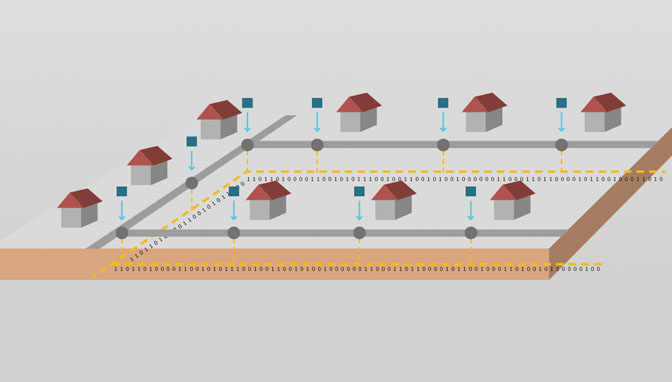
The end consumer—or, with the end consumer’s voluntary consent, the supplier—enters into an agreement with the grid operator to control adjustable consumption devices in a manner that benefits the grid, in exchange for a reduced grid fee; such control is limited in terms of timing and duration. To ensure the efficient use of grid operator interventions, local grid status data can be utilized to intervene specifically in grid congestion situations. This pertains both to the current application of Section 14a of the Energy Economy Act (EnWG) and to its planned further development. Control is achieved by the distribution system operator setting a maximum power limit at the grid connection point. Measurement and control are carried out via the iMSys. In exchange for granting the grid operator control access, the end consumer pays only a reduced grid fee. This grid-optimized control prevents grid bottlenecks in the low-voltage grid that could arise from the simultaneous power draw by controllable consumers, such as charging stations for electric vehicles or heat pumps. As a result, the power grid can be operated efficiently, safely, and reliably without the need to expand it or wait for such expansion to take place.11 – Measurement and Control for Redispatch 2.0
Redispatch is a tool used to adjust the planned operation of power plants (for example, by reducing the output of generation facilities) in order to resolve grid congestion. To date, it has been used primarily in the transmission grid; however, with its further development into Redispatch 2.0, it is now also relevant for the distribution grid. Redispatch 2.0 processes are currently mandatory only for facilities with a capacity of > 100 kW, but can also be extended to smaller facilities. The latter can also be controlled and monitored using the enhanced iMSys, enabling them to participate in Redispatch 2.0 processes in the medium term and contribute to preventing grid congestion. The iMSys is used to measure and transmit real-time data (actual feed-in) as well as to control the plant. The measurement also serves to determine the compensation for redispatch measures. The plant operator receives compensation for the power adjustment, which must not place the operator in a better or worse position than if the measure had not been taken. This distinguishes this EAF from EAF-1 (Section 14a EnWG), since here the curtailed feed-in for each measure (as well as any additional lost revenue) is financially compensated, whereas in EAF-1, an incentive is offered for accepting control interventions in consumption, e.g., through a lower grid fee. The use of Redispatch 2.0 prevents grid congestion. This allows the power grid to be operated efficiently, safely, and reliably, while leveraging the flexibility of the connected generation facilities.12 – Metering and Control for Direct Sales Under the EEG and KWKG
Direct marketing is the sale of electricity generated from renewable energy sources or mine gas to third parties. This marketing is carried out by a direct marketer who aggregates multiple plant operators. The generation and feed-in from the plants are then measured and controlled via the expanded iMSys, whose transmitted measurement values also form the basis for remuneration. Through direct marketing, plant operators and direct marketers benefit from a market premium and can thus achieve higher returns than the standard EEG feed-in rates. Direct marketing integrates renewable energy into the energy markets in a demand-oriented manner and enables the overall system to operate more efficiently. Based on the forecasts generated for direct marketing, grid utilization also becomes more predictable. Systems equipped with an expanded iMSys are enabled to participate safely in this direct marketing through access to measured actual feed-in data and control capabilities.Charging at publicly accessible charging infrastructure (EAF 7), charging at non-publicly accessible charging infrastructure with separate energy consumption tracking (EAF 16)
Learn More
7 – Charging at Publicly Accessible Charging Stations
By transmitting data and recording measurement values using the iMSys, the charging station operator enables the user of an electric vehicle to perform a charging process. Data collection and transmission serve the purposes of authentication, authorization, recording the amount of energy charged, and billing. Billing takes place either on the basis of a previously established ongoing contractual relationship or on an ad hoc basis (e.g., by credit card). Charging electric vehicles at public charging stations ensures mobility and geographic flexibility for charging station users. Providing public charging infrastructure in sufficient quantity and quality supports the growth of electric mobility. The charging station operator receives compensation from the charging service provider for the use of the charging point, which is generally based on the total amount of energy supplied to the charging service provider’s customers. In this context, the inclusion of the SMGW can enhance standardization and IT security in the long term.
16 – Charging at non-public charging infrastructure with separate tracking of energy consumption
An electric vehicle user charges their vehicle at home, or an employer provides charging infrastructure on its business premises to enable vehicle charging. In such cases, separate tracking of the charging energy may be necessary, for example, when a private individual charges a company car at home, when multiple users share a private charging station, or when an employer allows employees to charge their personal vehicles. The charging process recorded using iMSys provides energy and cost transparency for the user and ensures accurate differentiation of energy consumption and costs associated with charging sessions. Charging the electric vehicle ensures mobility for the charging station user. Providing charging infrastructure in sufficient quantity and quality supports the growth of electric mobility. In the long term, the involvement of the SMGW can enhance standardization and IT security.
3. Smart Metering and Submetering
Remote reading of personally identifiable and billing-related measurement data from the property’s submetering system (EAF 4), Remote reading of personally identifiable and billing-related measurement data from the main meter for various utility categories (EAF 5), provision of data for energy monitoring and value-added services for electricity (EAF 14), Remote reading of RLM electricity (EAF 17), remote reading of RLM gas (EAF 18)
Learn More
4 – Remote reading of personally identifiable and billing-related measurement data from the property’s “
” submetering system
The submetering service provider collects measurement data from the installed submeters (thermal energy meters, hot water meters, cold water meters) and heat cost allocators at a single property. The recorded meter readings relevant for billing must be made available to the authorized party via iMSys for billing purposes. Through remote reading of submeters in the submetering area, consumption data can be collected efficiently and accurately and transmitted securely via the SMGW. This efficiently combines the billing process with the reading of main meters via the SMGW and also enhances the legally required transparency of consumption for the connection user or subscriber, as well as data protection.
5 – Remote reading of personally identifiable and billing-related measurement data from the main measurement system at
for various service categories (multi-service metering)
The metering point operator collects, either periodically or as needed via the SMGW, the billing-relevant meter readings from the modern metering devices (main meters) for utilities (electricity, gas, drinking water, district heating/cooling) through which the building or unit is connected to the upstream distribution network, and transmits this measurement data to authorized market participants. The end consumer is provided with consumption data for all utility categories. The metering point operator or supplier can remotely read all utility meters simultaneously via the SMGW or the extended iMSys, either on a regular basis (e.g., annual reading) or on an ad hoc basis (change of owner, user, or supplier). In addition to meter readings, time series data from modern metering devices can be provided to increase awareness—for example, regarding energy consumption—or to enable dynamic pricing. This eliminates the costs associated with the previously required on-site meter readings for gas, drinking water, and district heating/cooling. Consumer transparency is ensured for end users across all utility sectors.
14 – Provision of Data for Energy Monitoring and Value-Added Services for Electricity
By enabling the metering point operator to collect and transmit high-frequency measurement values via the iMSys, authorized market participants can offer value-added services to connection users by monitoring and processing consumption data—and, in the future, generation data as well— in order to offer services such as energy consumption optimization. The end consumer must consent to the transmission of the data if they are interested in the service. As a basic application, the end consumer should be offered energy monitoring of consumption data locally and, optionally, via a web portal. This EAF builds upon TAF 14 and enables its future expansion. This may apply both to data on total consumption at the grid connection point and to data on the consumption of individual consumption units, to the extent that such data is available. Monitoring supports the energy transition by providing consumption transparency as the basis for more conscious—and thus more economical—energy use. According to the definition in the MsbG, value-added services are services unrelated to energy supply.
17 – Remote Meter Reading (RLM) for Electricity
Using iMSys as a load profile measurement system, the metering point operator records all billing-relevant meter readings from the digital electricity meter at the grid connection point, through which the building or unit is connected to the upstream distribution network, and transmits this measurement data to authorized market participants, such as suppliers, grid operators, and direct marketers. To ensure traceability and transparency of the measurements, as well as energy consumption optimization (local EMS), the iMSys provides the end consumer with the collected measurement values. Due to the measurement of high consumption levels associated with high energy costs, particularly stringent requirements are placed on the reliability and uninterrupted availability of the measurement values. Load profiles are securely recorded and transmitted and can thus be made transparently available to all authorized EMTs. The end user has full transparency into consumption and can use the data
.
18 – Remote Meter Reading (RLM) for Gas
Using iMSys for load profile measurement, the metering point operator records all billing-relevant meter readings from the digital RLM gas meter at the network connection point—where the building or unit is connected to the gas grid—and transmits this measurement data to authorized market participants. Depending on the use case, additional values (K-factor, gas quality, etc.) are fed into the meter. The end consumer can also view the consumption data, and this data can be transferred to a local EMS via interfaces.
Due to the measurement of high consumption levels associated with high energy costs, particularly stringent requirements are placed on the reliability and uninterrupted availability of measurement values. Load profiles are reliably recorded and transmitted and can thus be made transparently available to all authorized EMTs. The end consumer has full transparency into consumption and can utilize the data.
Collaborative Project and Partners
Project partners and associated partners:
E.ON Grid Solutions

We are an innovative online service provider that delivers excellent services and data to the E.ON Group’s customers and serves approximately seven million customers in the network business.
Power Plus Communications AG

Due to digitalization, power grids and properties are growing closer and closer together. With our innovative products and solutions, we combine the two worlds and create a secure and standardized platform for smart applications and services.
Robotron Database Software, LLC

Our practical software solutions deliver significant added value for your value-added processes and are complemented by comprehensive, customized, and customer-focused services.
TEAG Thüringer Energie AG; TMZ Thüringer Mess- und Zählerwesen

Whether it’s natural gas, electricity, or district heating, the leading energy provider in the Free State supplies more than 500,000 customers with essential energy every day. In addition, TEAG Thüringer Energie offers a wide range of energy-related services.
TMZ Thuringian Metering and Metering Services GmbH

We see ourselves as a full-service provider in the field of smart metering. We offer our customers a diverse portfolio of services as well as digital solutions across all sectors. We combine our knowledge and experience in both conventional and smart metering to serve as a reliable and efficient partner.
Project Objectives and Conclusions
Accelerated Implementation of Phase 3 of the Phased Approach
Advancing standardization in the areas of control and data transmission to ensure seamless use of the CLS channel. The project successfully completed technical validation of the following applications: Collection and transmission of grid status data (TAF 9 and 10) Collection and transmission of submetering data via the CLS channel Main metering for various sectors Provision of data for value-added services (TAF 14) Control of charging infrastructure via the CLS channel Control of consumption devices pursuant to Section 14a via the CLS channel
Design and development of features for subsequent stages of the roadmap
Looking ahead, we’re already thinking about the next steps and considering useful additions to the project’s functionality. During the project, many new features were further developed and tested in a lab environment: Direct control of generation plants from the SMGW using the EEBUS protocol Remote reading: RLM electricity via iMSys Control of generation plants via the CLS channel Data-efficient transmission of grid status data using threshold values
Development of Business Models and Value-Added Services for iMSys
Unlocking economic potential by identifying added value and leveraging it in sustainable business models. Development of business models centered on submetering Creating added value by reducing the amount of hardware required for direct control via the SMGW and by minimizing data usage through the use of threshold values during data transmission
Extensive testing and demonstration of iMSys functionalities within the framework of a real-world laboratory
The newly developed features are being demonstrated and tested in the field to gather key insights iteratively for ongoing development. Evaluation of the solutions in field tests conducted by TMZ and EGS Rollout in pilot locations and on corporate campuses for testing in test and production PKIs
Direct collaboration between the BMWK, the BSI, standardization bodies, and the project partners
Use of project insights to facilitate dialogue between the legislative branch and technical implementation. Quarterly direct dialogue with the BMWK and BSI Participation in and contribution to working groups focused on the digitalization of the energy transition Participation in industry consultations regarding regulatory developments during the project period
Publications
Fowards to Erfurt
On March 14 and 15, 2023, the consortium held another meeting in Erfurt at the offices of partner company TMZ. Last year, several laboratory setups at TMZ were already put into operation, and the partners were now able to tour them …
LEARN MORE
The Electricity Paradox
When there is particularly strong wind in the north, there is a particularly severe electricity shortage in the south, and power must be purchased from abroad, according to *WirtschaftsWoche* in January 2023. But how does an electricity shortage arise in the south when the wind is blowing fiercely in the north? …
LEARN MORE
Real-world lab accelerates the digital transformation of the energy transition
The five partners in the SMGW-forwards funding project are united by a single goal: to accelerate the digital transformation of the energy transition. In the three-year innovation project “SMGW-forwards,” they are investing a total of just under 10 million euros in two real-world laboratories, where the expansion of the smart metering system and new applications will be advanced …
LEARN MORE
Partner Meeting in Mannheim
At the invitation of Power Plus Communications AG, the project partners of the SMGW-forwards grant-funded project met at the company’s headquarters in Mannheim on August 25, 2022, to discuss the current status of the joint project …
LEARN MORE