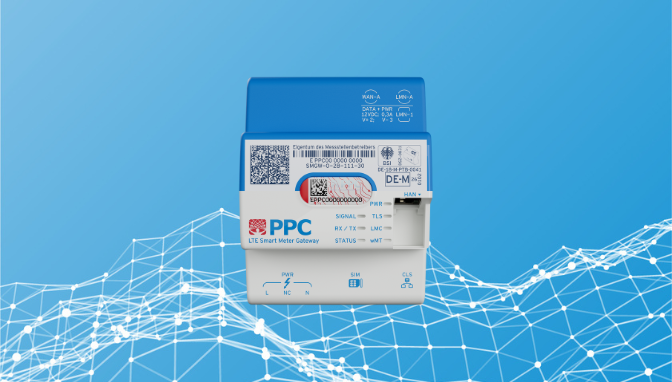

Ingo Schönberg, CEO of PPC, is pleased: “The recertification of our smart meter gateway marks another milestone in the digital transformation of the energy transition. A simple software update to the smart meter gateway unlocks a whole range of new features and added value. This successfully completes the first step in the BMWi/BSI roadmap.”
Janosch Wagner, Head of Smart Metering at PPC, adds: “We have continuously refined the firmware for our smart meter gateways since our first BSI certification at the end of 2018. The insights gained from real-world operation over the past two years have been incorporated into this further development. During the recertification process, the updated firmware was thoroughly evaluated and approved by an independent testing agency, the PTB, and the BSI. The new firmware is now available for remote update by the gateway administrator. For new smart meter gateways, it can be installed directly during production.”
Maximum flexibility and interoperability
The new firmware further enhances the interoperability of PPC SMGWs for the wide variety of system solutions available on the market. Particular emphasis was placed on data acquisition via new wired and wireless meters and on interaction with all commercially available GWA systems. In addition to systems from BTC, Bosch, Görlitz, Next Level Integration, Robotron, Sagemcom Fröschl, Schleupen, Siemens, and Thüga SmartService, the recertification has also incorporated compatibility with Tremondi’s GWA software into PPC’s type examination certificate. This enables PPC to offer its customers the greatest possible flexibility in terms of both systems and meters.
Thanks to optimizations in meter reading acquisition and processing, meter site operators now also receive more detailed information on meter readings as well as the SMGW and meter status. In addition, the use of meter readings in MaKo has been simplified. In addition to these operational improvements based on our practical experience, the implementation of the TAF 9, 10, and 14 tariffing functions in accordance with the Technical Guideline is a key component of the recertification process.
Network operators and end customers benefit
Both grid operators and end users benefit from these new use cases. TAF 9 can be used to measure the current actual feed-in from generation plants into the distribution grid, as required, for example, by the amended Renewable Energy Sources Act (EEG). TAF 10 transmits real-time grid status data, such as phase angles and voltage.
Eugen Mayer, CEO of PPC, explains: “Thanks to the high-frequency transmission of measurement data, grid operators can continuously monitor the grid and its facilities, detect critical conditions early on, and thus avoid grid bottlenecks. This real-time transparency is essential for efficiently managing the increasingly decentralized feed-in of renewable energy and the integration of e-mobility into distribution grids.”
Transparency in Energy Consumption for End Customers
With TAF 14 (High-Frequency Metering Data Provision), service providers and metering point operators can also offer visualization of high-resolution consumption data and services based on it. In addition to active and reactive energy data, this TAF also allows instantaneous power values to be recorded and securely transmitted to backend systems.“Transparency in energy consumption is the foundation for energy efficiency, variable rates, and end-customer investment decisions aimed at optimizing energy use. Without transparency, an efficient energy and transportation transition cannot take place,” Schönberg summarizes.
High-resolution data provides end customers with detailed insight into their energy consumption, allowing them to identify energy-wasting appliances or better calculate investments in renewable energy systems, energy storage, and electric mobility. Upon customer request, disaggregation algorithms can even identify characteristic consumption patterns for individual household appliances. This data forms the basis for a wide range of new services, ranging from consumption optimization to metrics for senior care.
Successful Field Tests
The new gateway functions have already been extensively and successfully tested in real-world conditions with many customers. For example, by the E.ON subsidiary e.Kundenservice Netz in Hamburg and the distribution system operator Bayernwerk. As part of the C/sells project, TAF 9 and 10 were extensively tested in the Bavarian grid area in collaboration with the Forschungsstelle für Energiewirtschaft e. V.