
Mannheim / Oldenburg, May 16, 2023: The unIT-e² research project is moving from the laboratory phase to the practical phase. In the project’s subcluster called Harmon-E, test participants have now been successfully equipped with a digital grid connection consisting of SMGW and HEMS. This means that the controllable grid connection, as defined in Section 14a, can now be tested in live operation. The project expects this to yield new insights into the necessity of control interventions and to provide valuable knowledge for grid monitoring.
More renewable energy in the grid also means more volatile generators and consumers. These place unique demands on the power grid of the future and on end-customer participation. Millions of electric cars, heat pumps, and PV systems should be able to coordinate their operations in real time as effectively as possible. Only in this way can grid operators in their respective regions reduce the need for control interventions—which are necessary for grid stability—in the future. These interventions are inefficient and costly. The key lies in decentralized control at the grid connection points of individual users and consumers. Through small load adjustments at many locations, the goal of sustainably ensuring grid stability can be achieved more efficiently—and thus at a lower cost. In the future, grid-optimized control will be carried out with surgical precision, involving end customers, rather than through broad, sweeping measures applied across the entire grid area.
To this end, testing the entire control chain—from the grid operator all the way down to individual properties—is the most important step toward making this a reality. The unIT-e² innovation project has been addressing these issues since 2021. It is funded by the BMWK for three years as part of the “Elektro-Mobil” funding call. The project is managed by the German Aerospace Center (DLR). In the Harmon-E cluster, testing is now shifting from the laboratory environment to field testing in order to assess the practical feasibility of grid-friendly control at the grid connection point, as defined in Section 14a of the Energy Economy Act (EnWG), on a larger scale. In two local grids in Oldenburg and Rastedes, participants in the test field were equipped with wall boxes and electric cars in their single-family homes; in some cases, PV systems were also integrated into the test field.
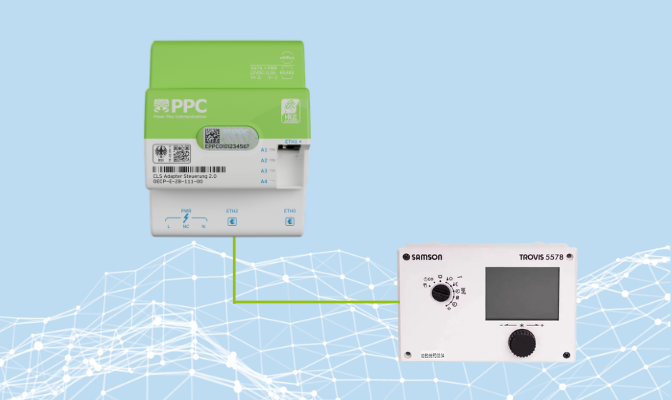
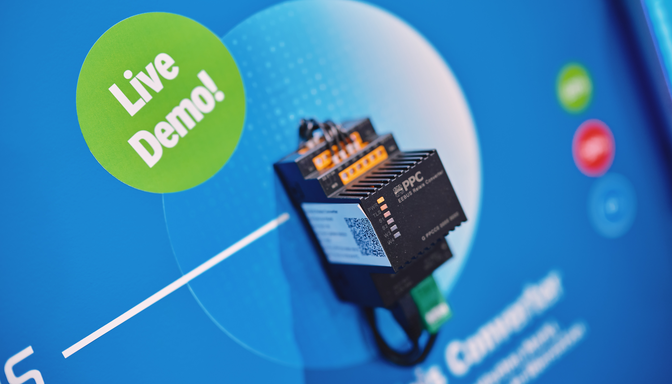
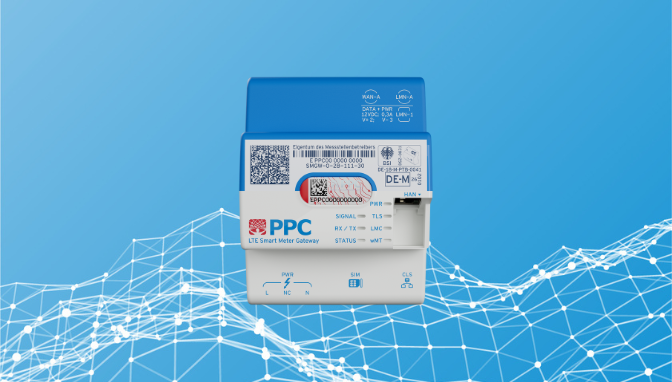
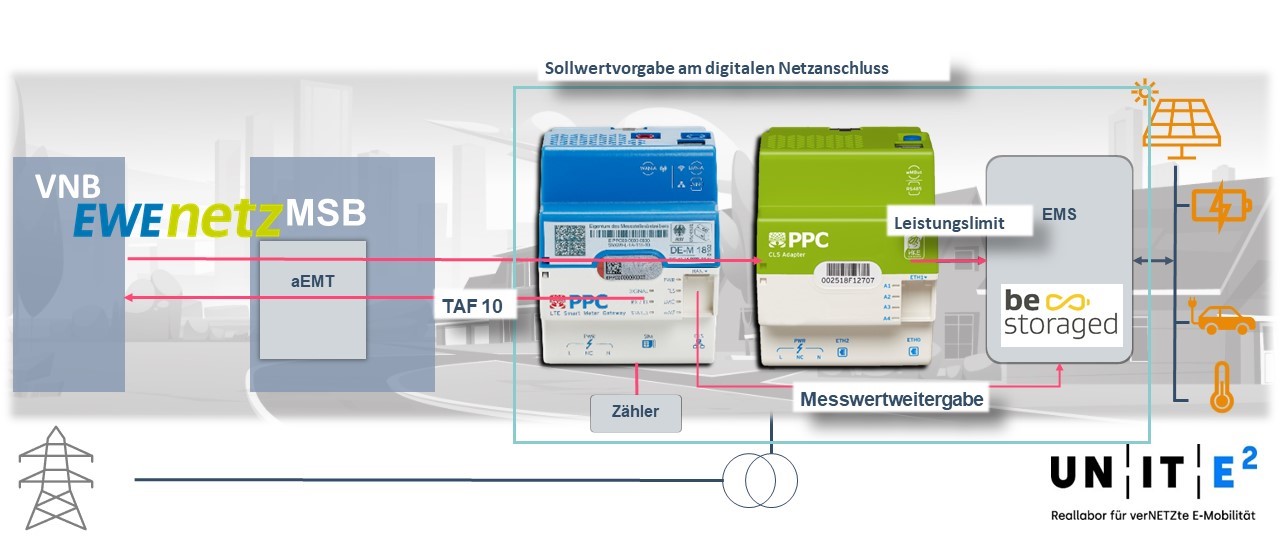
Specifically, EWE Netz, as the responsible grid and metering point operator, transmits the setpoint specifications for stabilizing the distribution grids to the digital grid connection point. The target value is transmitted (from the backend system) via the secure CLS interface from the PPC SMGW to the PPC CLS gateway. The PPC CLS gateway transmits the power limit for the grid connection point via EEBUS to the connected home energy management system (HEMS) of Oldenburg-based be.storaged GmbH. The HEMS optimizes the customer’s systems and implements the power limitation at the wallbox provided by EWE Go. To enable power limitation at the grid connection point, the SMGW also provides the measurement values from the grid connection to the HEMS. The advantages are clear: not only does this eliminate the need for additional measurement equipment, but it also ensures that all measured values comply with calibration regulations. This facilitates the transfer of field test results into everyday user scenarios, as the test environment closely mimics real-world conditions.
This setup demonstrates that by further developing the PPC CLS gateway into a control unit—in combination with the provision of measurement data via the PPC Smart Meter Gateway—the groundwork is being laid for future areas of application. The digital grid connection—consisting of the combination of the SMGW and the CLS gateway/HEMS—lays the foundation for implementing grid-friendly control.
In the upcoming test phases, control commands will be used to determine how much flexibility can be maintained within the property and what positive effects this can have on grid stability. The test phase is scheduled to be completed by the end of 2023, after which the project partners will conduct a final evaluation of the findings. In the long term, all participants in the energy sector as well as end customers will benefit from the results; furthermore, the findings can be incorporated into future implementations of the control system under Section 14a. This positive development will benefit not only grid operators and grid stability but ultimately also end users in the form of lower costs and efficiency gains.