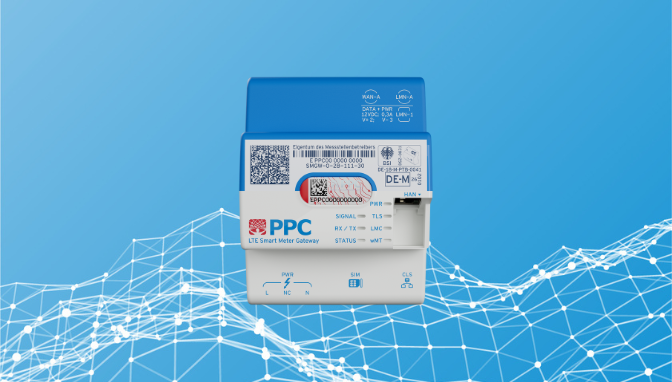

The importance and prevalence of electric mobility in the context of the cross-sector energy transition are growing steadily. Intelligent and grid-friendly charging management—in compliance with legal requirements, including those set forth in the Metering Point Operations Act and calibration regulations—is the key factor for success in this regard. This primarily requires up-to-date data on the status of the power grid, which is provided by connecting the charging infrastructure to the smart metering system. The Smart Meter Gateway (SMGW) serves as a highly secure data transmitter and enables the control of charging stations as well as, in the future, the reconciliation of target and actual data.
Already today, PPC’s certified SMGWs provide the foundation for an interoperable solution for grid-friendly and metrology-compliant charging processes. To this end, PPC relies on close collaboration with innovative industry partners in various research projects to ensure seamless integration into existing systems via standardized interfaces to the charging infrastructure.
Use of the CLS Channel to Control the Charging Infrastructure
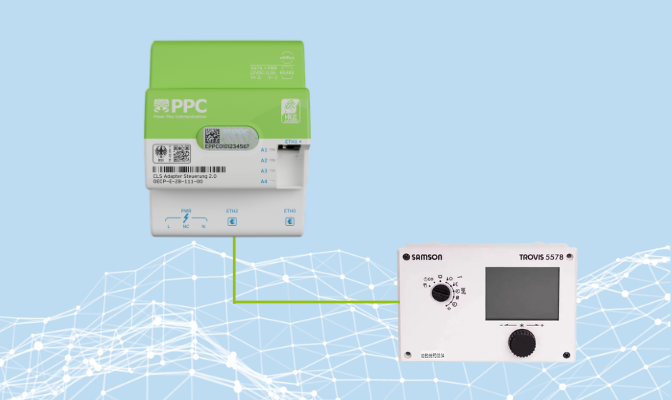
The SMGW enables highly secure and traceable control of charging processes from a backend system or the setting of target values for energy management systems. As with grid-friendly control of energy-intensive household appliances, the charging infrastructure is controlled as a Controllable Local System (CLS) via the SMGW’s corresponding interface. To achieve this, either the individual charging station or an energy management system can be controlled directly, ensuring that the charging infrastructure is equipped for grid-compatible integration into the power grid and future-proof operation.
Charging in Various Scenarios
Charging processes can be categorized according to various criteria. In the simplest case, the charging infrastructure is billed as another consumer using household electricity and is controlled directly via the SMGW’s CLS channel or through an energy management system connected to the SMGW. Thus, this scenario differs little from the familiar control of any CLS device, in which the SMGW serves merely as a transparent communication proxy for the connection between an external market participant’s backend system and the CLS-connected installation. For residential customers, the consumption data relevant for billing is typically recorded by a central meter at the service entrance and stored in the SMGW connected there. The control of CLS-compatible charging infrastructure, as well as the short-term integration of (existing) installations via a CLS gateway, is already feasible today.
If the charging infrastructure is used by multiple billing recipients, the challenge lies in recording the charging energy in a manner that complies with metrology regulations and is specific to each user, to enable billing accurate to the kilowatt-hour. Since customers can theoretically charge at any charging station depending on their contracts, an n:m relationship exists between customers and charging stations, which places high demands on the billing of charging sessions. In addition, these charging points must be controlled to support the grid, and their available draw power must be reduced or curtailed in the event of grid congestion. For Vehicle-to-Grid (V2G) use cases relevant in the medium to long term, it must also be possible to record the power fed into the grid and attribute it to the owner of the vehicle in question. PPC is working on these challenges in collaboration with industry partners, standardization bodies, and policymakers.
Current Research Projects
PPC is actively working to further develop the framework for user-friendly implementation of the SMGW in the charging infrastructure and is involved in the BMWi/BSI “Smart Mobility” task force. In addition, PPC is participating in various research projects funded by the BMWi:
- LamA-Connect: A project under the “Clean Air” Emergency Program for metrology-compliant charging and billing of charging sessions via the SMGW and grid-optimized control of charging sessions via the CLS channel.
- Bidirectional Charging Management: A research project on the integration of bidirectional electric vehicles into the energy system. As part of this project, PPC is supplying smart meter gateways to Bayernwerk Netz GmbH for the “Smart Metering System” subproject.
- Enera: Project under the SINTEG program. In the “Grid4Mobility” use case, PPC is working with its project partners to investigate a scenario for grid-optimized control of charging processes based on driving schedules.