

SISSY – SMGW as a Safety Anchor for Control in an Interconnected System
As the energy transition progresses—and particularly in light of current geopolitical developments—one of the greatest challenges in the coming years will be to continue ensuring security of supply and economic efficiency amid a generation and consumption landscape that is becoming increasingly diverse and fragmented. At the same time, current regulatory developments are increasing the pressure to act: Scalable solutions based on the standardized SMGW ecosystem for the controlled integration of an exponentially growing number of generation and consumption facilities into the power grids must be developed, tested, and made available to the market as quickly as possible. This is precisely where the SISSY project, funded by the Federal Ministry for Economic Affairs and Climate Action, comes in. The consortium builds on the successful collaboration and insights already gained from the predecessor project, SMGW-forwards.
Alignment with Regulatory Requirements
To ensure that the applications and new developments can be implemented in practice, there will be continuous feedback from the project results to the regulatory framework throughout the entire project duration. On the one hand, this allows the consortium to respond more flexibly to regulatory changes, and on the other hand, the project can provide input for standardization. The legal framework is shaped through:
- Contributing project insights to roadmap discussions through participation in relevant working groups and task forces.
- Targeted, regular discussions on project progress with the BMWK, BSI, BNetzA, and other relevant stakeholders
- The project’s participation in ongoing consultation processes
- Partner-Specific Participation in Relevant Committees and Associations
Project Objectives
Suitability for mass production
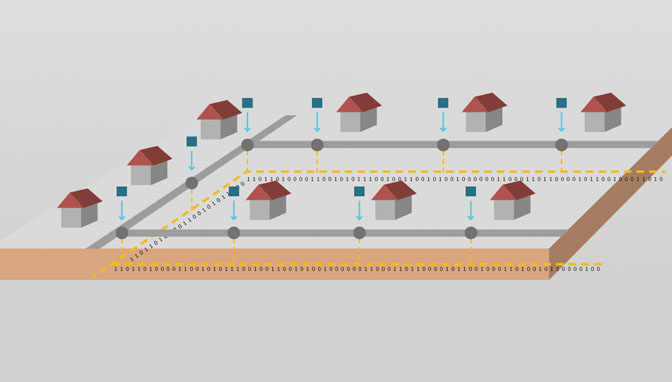
To enable the widespread implementation of control via the iMSys infrastructure, the project will further develop the control system directly from the SMGW and test it in practice to increase efficiency by reducing hardware requirements and simplifying processes. In addition, the associated installation processes will be refined so that they meet the requirements of a mass rollout during commissioning:
Cost-Effectiveness
The design of the iMSys infrastructure improves cost-effectiveness for metering point operators. In addition, the project consortium aims to further develop the core benefits of smart metering systems for end customers, for example, by marketing their flexibility or through variable rates.
Acceleration
How can our solutions accelerate the digital transformation of the energy transition?
The goal of our solutions is to resolve the current challenges of the rollout as quickly as possible and to contribute to the development of standards. Within the framework of SISSY, these solutions can be tested in real-world labs along the entire system chain, with the consortium partners covering the entire value chain. This ensures early fault detection throughout the entire system.
Use Cases
Grid-Optimized Control
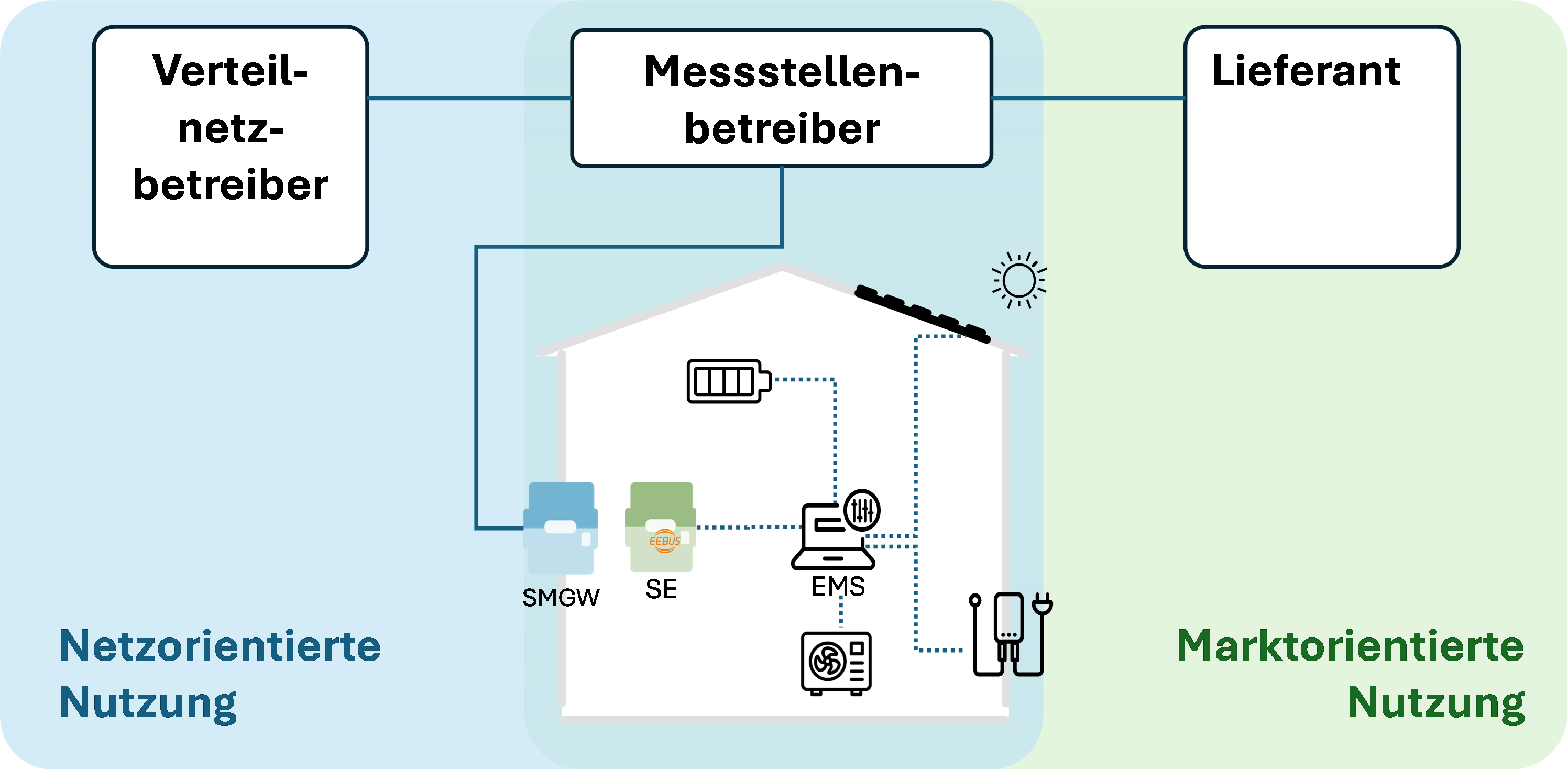
The adoption of Section 14a of the Energy Economy Act (EnWG) and Section 9 of the Renewable Energy Act (EEG) authorizes the grid operator to control flexible loads—such as wallboxes—or generation facilities—such as PV systems—in the low-voltage grid in the event of an impending grid congestion. There are various implementation options for grid-supporting control, most of which are still in the prototype stage. Within the scope of this use case, control solutions are to be developed that are ready for mass deployment. In addition to commissioning, the real-world laboratory will test the control system’s resilience to communication failures as well as the secure and reliable logging of control processes in the SMGW.
Market Applications
In the future, not only grid operators but also other market participants should be able to benefit from using the iMSys infrastructure. By using the secure communication channel provided by the metering point operator, new business models are opened up for suppliers and direct marketers, for example, by allowing them to send market signals—such as variable rates, control commands for systems, or 24-hour envelope curves—to specific low-voltage properties.
System Services
In an evolving energy generation system, decentralized flexibility sources < 100 kW are becoming increasingly important for system security and stability between electricity generation and consumption. The project investigates how the iMSys communication infrastructure and the measurement data collected there can be used to integrate such micro-flexibility into the market. This will enable participation in system services such as control power and allow the transmission system operator to manage aggregated micro-flexibility resources for Redispatch 2.0. The goal is to proactively prevent grid overloads.
Large-Scale Plant Control
The consortium is investigating the feasibility of transmitting control commands to large-scale generation facilities > 100 kWp. To this end, a suitable measurement concept must first be developed that defines the relevant measurement parameters and their sampling rates. In addition, the specific requirements and operating environments must be taken into account.
White Paper on the Digital Controlability Assessment
With its digital controllability check based on intelligent metering systems (iMSys), the SISSY Consortium is demonstrating a new, scalable approach to verifying the controllability of generation facilities. This approach makes it possible to demonstrate fundamental controllability efficiently, in a manner that benefits the grid, and without physical interventions or test-based curtailment of renewable generation capacity. This establishes a method that is particularly well-suited for large fleets of plants and meets the growing demands of the energy transition.
Discussion Paper on the Envelope Curve (EEBUS Use Case POEN)
The energy transition is increasingly shifting to low-voltage grids: photovoltaics, electric mobility, heat pumps, and home storage systems are driving up both feed-in and peak loads. This poses growing challenges for grid stability, but at the same time, the smart use of flexibility creates significant economic potential. Our discussion paper aims to show how the existing iMSys infrastructure can be used to evolve from a primarily curative approach to a market-oriented, preventive management strategy. The key lies in the concept of the envelope curve.
Role of PPC
As a BSI-certified manufacturer of SMGW, PPC is responsible in its subproject for the core task of significantly expanding the functionality of the SMGW communication platform by further developing the iMSys hardware and software. The main objectives are to upgrade the iMSys to enable the control of large-scale generation facilities, to expand documentation capabilities, to provide system services, and to implement local control functions on a large scale. Based on the results, proposals regarding the regulation and acceleration of the rollout, as well as technical standards, will be developed and incorporated into the roadmap process and presented to relevant committees and associations.
Collaborative Project and Partners
Consortium partners and associated partners:
E.ON Grid Solutions

EGS acts as the primary metering point operator (MPO). In this role, the partner defines specific requirements and the technical implementation of project-relevant use cases, contributes its practical experience as well as that of its affiliated network operators, and applies project insights to current processes. In addition, EGS, together with the consortium, tests the new developments in laboratory environments and field tests.
Power Plus Communications AG
As a certified manufacturer of SMGWs and CLS devices, PPC takes on the requirements of metering point operators and implements them using interoperable hardware and software solutions that are initially developed as prototypes. In its role as consortium leader, PPC also handles coordination tasks within the project and ensures its success.
Robotron Database Software, LLC
![]()
Robotron is contributing its GWA and EMT solutions to the project, which are required for the MSB backend.
TMZ Thuringian Metering and Metering Services GmbH
TMZ acts as an associate partner under contract to TEAG as the implementing MSB for both basic-service and competitive MSBs. In this role, the partner defines specific requirements and the technical implementation of project-relevant use cases, contributes its practical experience as well as that of its affiliated network operator companies, and applies project insights to existing processes. In addition, TMZ, together with the consortium, tests the new developments in laboratory environments and field tests.
EEBUS e.V.

The EEBUS Association is responsible for the expansion and operation of the Living Lab, with a focus on iMSys. It also adapts the technical interfaces to the project’s specific requirements and incorporates them into the existing standard.
KEO GmbH

KEO is expanding its software solution package to include the use cases for the EEBUS SPINE language required for the project and is implementing its software in the corresponding end devices, applications, and the KEO EEBUS test system.
Lumenaza, LLC
![]()
Lumenaza’s innovative SaaS platform for direct marketing and dynamic electricity rates enables highly efficient management of all energy industry processes, such as market communication, feed-in forecasting, balancing group management, electricity trading, and billing. As a direct marketer, Lumenaza brings over 10 years of experience in the energy sector to the SISSY project, to test the transmission of TAF 9 meter readings from the smart meter gateway and market-related control processes via the smart meter gateway infrastructure, and to develop proposals for processes suitable for mass deployment.